Cosmic Princess Kaguya! — Who Gets to Write a Happy Ending? An ancient moon princess, a virtual stage, and the courage to stop being only an audience


Table of Contents
This essay contains story and thematic spoilers for Cosmic Princess Kaguya! without revealing every turn of its ending.
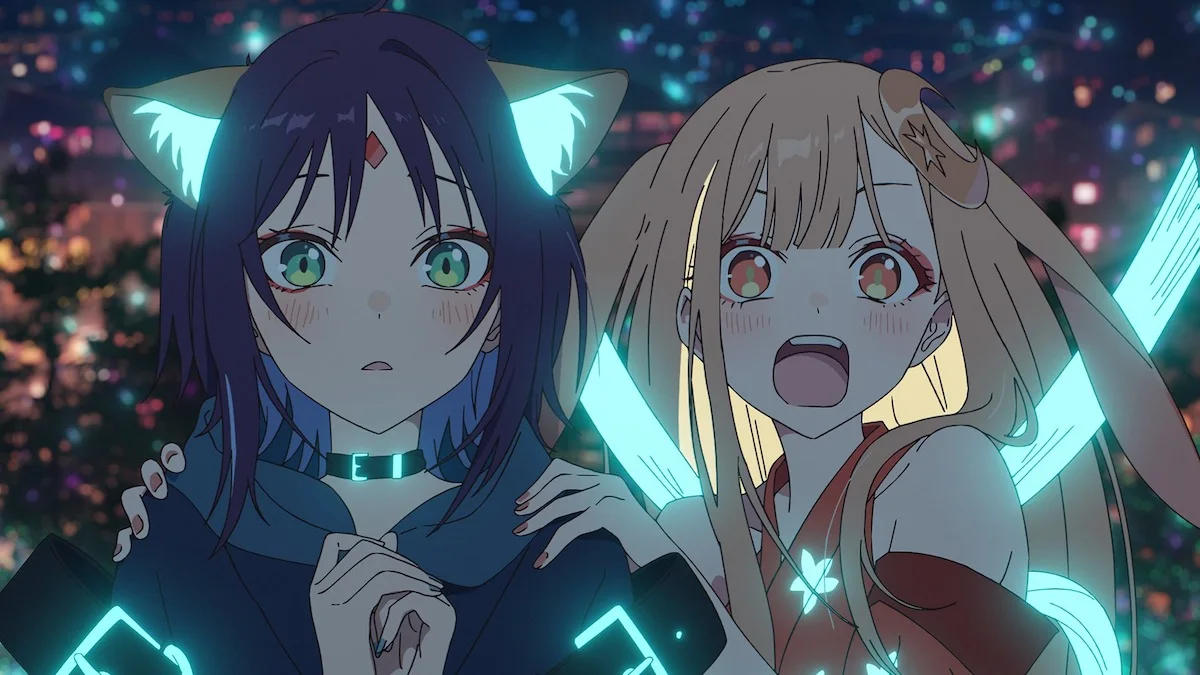
Iroha and Kaguya in Tsukuyomi. Official still via Netflix Tudum. ©コロリド・ツインエンジンパートナーズ.
At first glance, Cosmic Princess Kaguya! sounds like a collision designed to be impossible to ignore: one of Japan’s oldest stories, a virtual world shaped by streamers and avatars, concert-scale action, and a soundtrack assembled from some of Vocaloid culture’s defining creators. It could easily have become a clever update that changed the setting while leaving the old tale untouched.
Instead, Shingo Yamashita’s film finds its real subject inside that act of updating. It asks what happens when a character learns that her ending was written centuries before she was born—and decides that the story has no right to keep it.
That question belongs to Kaguya, of course. But it also belongs to Iroha Sakayori, the exhausted 17-year-old student who finds a baby inside an iridescent “gaming” telephone pole, watches her grow into a girl overnight, and reluctantly lets her into a life with almost no spare room. Kaguya arrives from the Moon with too much energy. Iroha has survived by allowing herself too little. Their meeting gives the film its central tension: one girl refuses every limit, while the other has learned to call limits reality.
A bad ending inherited from the oldest story
In The Tale of the Bamboo Cutter, Princess Kaguya’s return to the Moon is inevitable. Earth gives her attachment, beauty, and grief; the celestial realm eventually takes her away. The ending hurts precisely because no human desire can overrule it.
The new Kaguya’s response is wonderfully direct: that is a terrible ending, so she will find a happy one.
Her rebellion initially looks like another joke produced by her bottomless confidence. Yet it becomes the film’s governing idea. Fate is not only the army waiting above Earth. It is any finished narrative that tells a person what kind of life is reasonable before she has had the chance to choose.
Iroha lives under a quieter version of the same pressure. School, work, and money have reduced her days to tasks that must be completed. She once made music, but creativity is difficult to defend when every hour needs a practical use. She has not stopped wanting a different life; she has simply become too responsible to admit that wanting should matter.
Kaguya does not rescue Iroha from that life. She disrupts it. She turns up the volume on desires Iroha had learned to mute.
Tsukuyomi turns spectators into creators
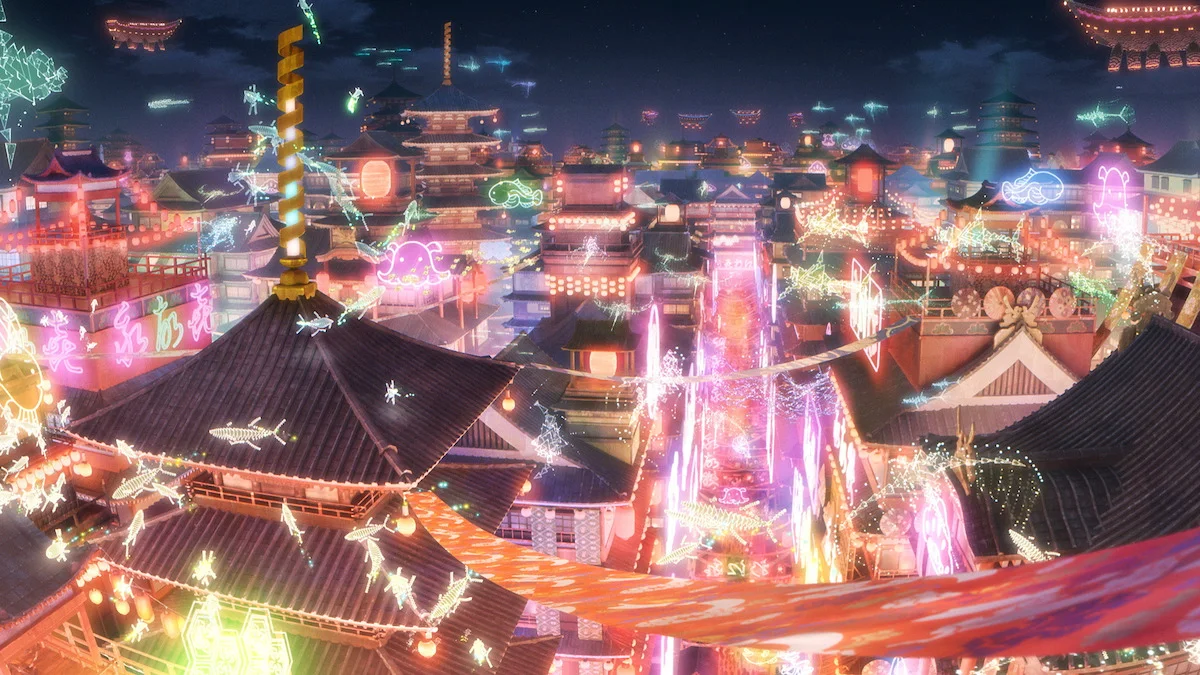
Tsukuyomi combines old architecture, live stages, games, and luminous digital creatures. Official still via Netflix Tudum. ©コロリド・ツインエンジンパートナーズ.
The virtual realm of Tsukuyomi is more than the film’s spectacular backdrop. It is a place where people can construct avatars, perform, compete, make things, and try out versions of themselves that ordinary life has not made room for.
Before Kaguya arrives, Iroha uses that freedom cautiously. She watches Tsukuyomi’s top streamer and administrator, Yachiyo Runami, and earns a little money through battle games. Fandom offers comfort without exposure: Iroha can admire someone else’s creativity while keeping her own safely hidden.
Kaguya ruins that arrangement in the best possible way. She wants to sing, stream, and reach the top, and she needs Iroha to produce the music. Their partnership moves Iroha across the boundary between audience and creator. She is no longer merely consuming a world built by other people; she is adding something to it and accepting the risk that somebody might answer.
That is why the film’s affection for internet culture feels unusually sincere. Tsukuyomi has rankings, monetization, performance, and noise, but the movie never treats online life as an inferior copy of the “real” world. The selves people make there can be playful without being false. The relationships are real because the attention, labor, embarrassment, and joy invested in them are real.
Yamashita has described the film as carrying his affection for internet culture stretching back to the 1990s. On screen, that history appears not as trivia but as a belief: the internet is at its best when it lets a spectator become a participant.
The soundtrack is the internet remembering itself
The music makes that belief audible. The film brings together ryo (supercell), kz (livetune), 40mP, HoneyWorks, Aqu3ra, and yuigot, creators whose work belongs to different generations of a culture built through uploads, remixes, synthetic voices, fan responses, and songs traveling farther than their makers could predict.
Their presence is not a row of nostalgic cameos. It gives the film a cultural memory. A story about an ancient princess is being rewritten through a creative scene that has always blurred the borders between professional and amateur, singer and software, author and audience.
Even the song titles carry the argument. Kaguya sings “Watashi wa Watashi no Koto ga Suki”—“I Like Who I Am”—while the film’s main theme, performed by Yachiyo, is “Ex-Otogibanashi,” or “Ex-Fairy Tale.” One insists on the self in the present; the other announces a departure from the inherited story. Music does not pause the plot. It is how these characters state who they are before the world states it for them.
The live sequences are appropriately overwhelming. Yamashita’s dynamic camera moves through stages, interfaces, crowds, and combat as if an anime opening had expanded until it became a place the characters could inhabit. The excess matters. Kaguya is fighting a fate defined by serene inevitability, so her answer is color, motion, noise, and the refusal to disappear politely.
Love is made in the room behind the avatar
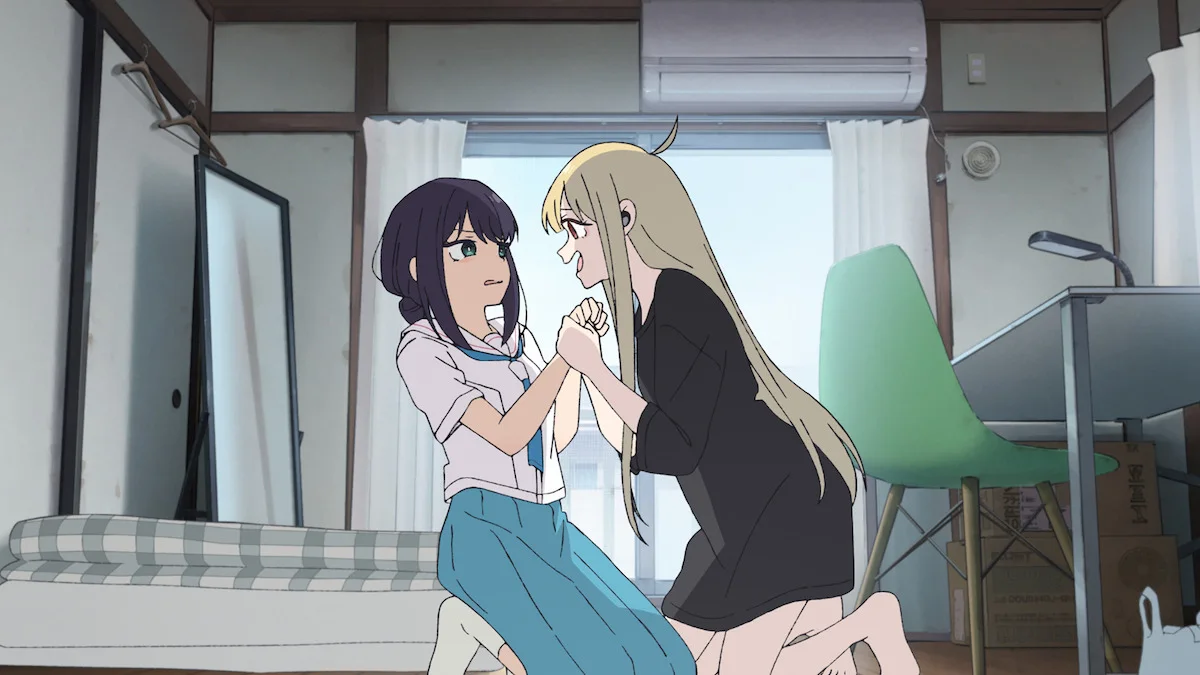
The film’s cosmic scale keeps returning to the ordinary room Iroha and Kaguya share. Official still via Netflix Tudum. ©コロリド・ツインエンジンパートナーズ.
For all its visual ambition, the film earns its emotion in a cramped apartment. Away from their avatars, Iroha and Kaguya have to share time, work, frustration, and care. Kaguya’s freedom can be selfish; Iroha’s responsibility can become a way of refusing help. Their closeness grows because each girl gradually recognizes what the other’s survival strategy cannot provide.
Kaguya gives Iroha permission to want. Iroha gives Kaguya’s wanting shape, patience, and a home.
Viewers can name their bond in different ways—friendship, family, romance, or something deliberately held between categories. The film does not need to settle the label to make its commitment clear. These two do not merely improve each other’s lives. Each becomes part of the future the other is trying to protect.
This is where Cosmic Princess Kaguya! most decisively changes the old tale. Its happy ending is not a prize waiting at the end of a successful quest. It is a collaborative work: a song written by one person and carried by another, a private feeling given public form, a future that neither girl could imagine alone.
A finale too large for its own movie
At 143 minutes, the film is not always as graceful as its animation. Its final movement expands across mythology, technology, memory, and time, then deliberately plays with the feeling that the story has already ended. Some of its mechanics arrive faster than the emotions can explain them. The movie occasionally asks attachment to bridge gaps that its worldbuilding leaves open.
That messiness will be the dividing line for many viewers. It is also difficult to separate from what the film is attempting. A perfectly sealed conclusion would risk reproducing the authority of the folktale it wants to challenge. Instead, the ending keeps opening doors. It treats narrative closure as something that can be contested, answered, and revised.
The result is less elegant than a tragedy—and more alive.
A happy ending is a creative act
Released on Netflix on January 22, 2026, Cosmic Princess Kaguya! is Yamashita’s first feature-length directorial work, with animation production by Studio Colorido and Studio Chromato. Its technical achievement is immediately visible. Its more lasting achievement is the generosity with which it looks at people who sing, stream, compose, play, watch, and eventually decide to make something themselves.
The film does not argue that creativity can prevent loss. It argues that creation changes what loss is allowed to mean. A voice can cross a distance. A song can preserve an answer. A person who was told to accept the ending can make the story continue in another form.
Kaguya begins by rejecting a bad ending as if confidence alone can defeat it. Iroha eventually offers the more difficult response: if the ending is unacceptable, somebody has to do the work of writing beyond it.
That may be the film’s loveliest idea. A happy ending is not something one girl finds waiting for her. It is something two people make—and keep making—together.